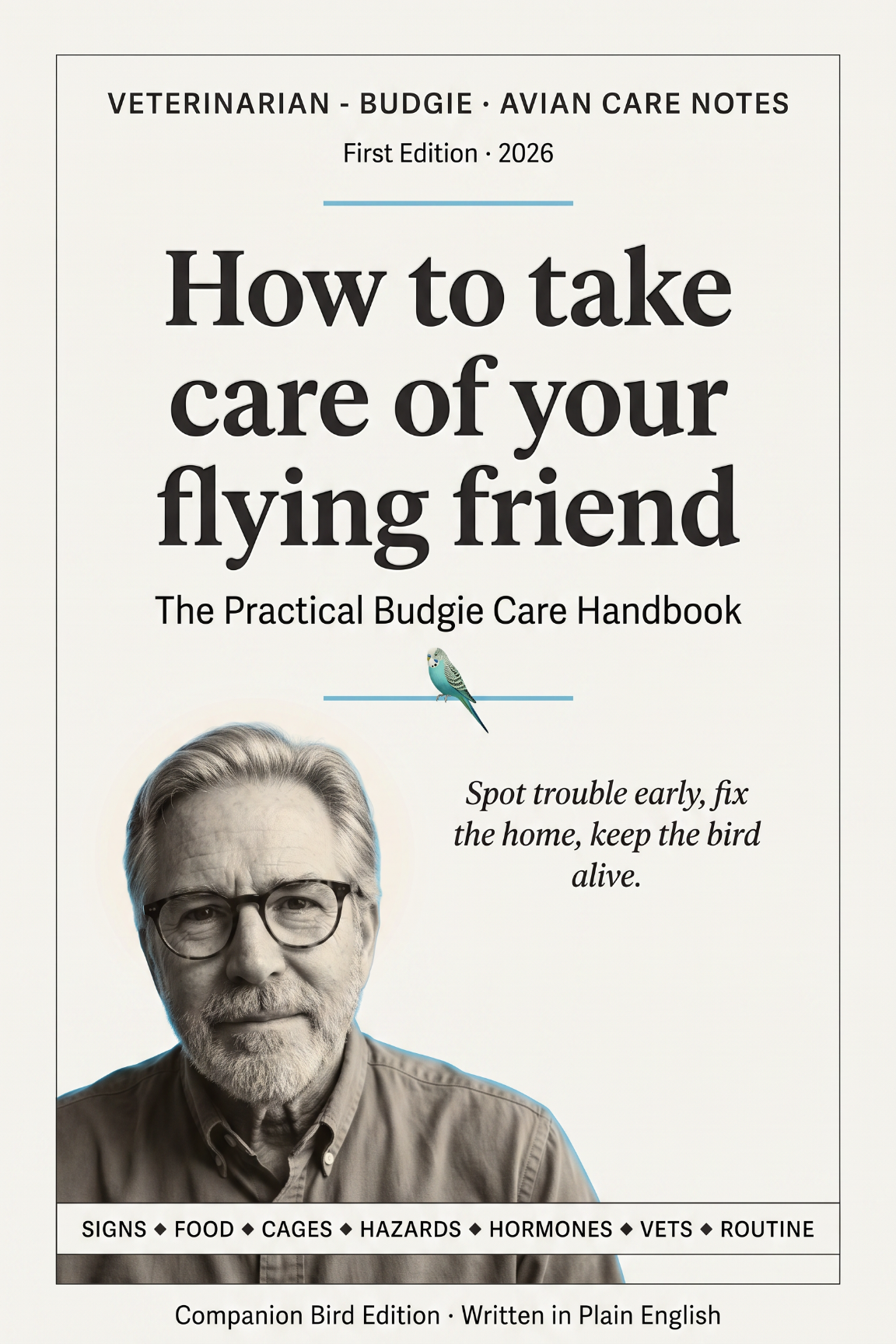
How to take care of your flying friend
The Practical Budgie Care Handbook. Spot trouble early, fix the home, keep the bird alive.
- 219-page PDF with 35 practical chapters.
- Emergency signs first: breathing, blood, collapse, egg straining, appetite loss.
- Food, cages, hazards, stress, hormones, vets, and weekly checks.
- Instant access, printable pages, free lifetime updates to this edition.
Seven-day refund window. This book supports veterinary care; it does not replace it.
Specific care decisions, not vague bird advice.
Each line in the book is aimed at a choice an owner has to make at home, at the cage, or before calling the clinic.
Separate mild-looking behavior from emergency signs: fluffed stillness, open-mouth breathing, tail bobbing, blood, collapse, seizures, inability to perch, egg straining, and sudden appetite loss.
Learn why a budgie can act normal while hiding illness, and what posture, routine, droppings, weight, appetite, and breathing can show first.
Set up a new bird without grabbing, chasing, crowding, or moving the cage every hour.
Understand feces, urates, urine, cage paper, watery output, undigested seed, color changes, and blood.
Use a gram scale, step-on training, weekly numbers, and a printable log so weight loss is seen before the bird looks weak.
Identify non-stick fumes, self-cleaning ovens, aerosols, smoke, paint, sprays, candles, incense, and diffusers before exposure happens.
Sweep for windows, mirrors, doors, fans, boiling pots, aquariums, toilets, sinks, and open flames before the cage door opens.
Understand why supervision is not the same as safety around cats, dogs, larger parrots, and young children.
Use measured seed, pellets, vegetables, clean water, safe treats, transition safeguards, and refusal signs without starving the bird.
Judge usable length, bar spacing, doors, coatings, sharp edges, feeder placement, perches, and clearance.
Spot sleep loss, forced handling, mirrors, loud rooms, boredom, irregular feeding, predator staring, and constant disturbance.
Know what to ask the front desk, what records help, how transport works, and why waiting overnight can cost the bird time it does not have.
A budgie can look almost normal until the margin is gone.
Small birds do not give owners long dramatic warnings. They often give small, boring ones. The book teaches those.
A budgie that is quieter for one day may still climb, eat at the dish, and look awake when watched. That does not make the bird well. Illness hiding is a survival behavior. The flock does not reward weakness.
That is why this handbook starts with emergency signs. Open-mouth breathing, repeated tail bobbing, collapse, seizures, blood, inability to perch, egg straining, and sudden appetite loss are not “monitor and see” signs. They are clinic signs.
The same logic applies to the home. A pan on the stove, a closing door, a ceiling fan, a scented spray, a cat paw through bars, a seed-only bowl, and a narrow decorative cage are ordinary things. Ordinary things kill birds when nobody has named the risk.
The answer is not panic. The answer is a loop: weigh weekly, check droppings, watch breathing, clean the right places, track food intake, inspect feet and beak, and write down changes before memory edits them.
| Owner assumption | What the book teaches instead | Why it matters |
|---|---|---|
| “He is still eating.” | Check whether he is eating or only cracking seed and dropping hulls. | Budgies can pretend at the dish while intake falls. |
| “She is just quiet.” | Compare chatter, sleep, perch height, posture, and breathing to her normal routine. | Quiet can be contentment. It can also be conservation. |
| “The cage says it is for budgies.” | Measure usable length, bar spacing, door safety, perch layout, and clearance. | Labels sell cages. Birds live inside them. |
| “The cat only watches.” | Use separate airspace, closed doors, and no shared access. | One safe meeting proves almost nothing. |
Written in clinic-table language by veterinarian - BUDGIE.
No cute shortcuts. No home treatment plan for emergencies. Just the care points owners need to stop missing.

“My job in these pages is simple: name the sign, name the risk, name the next sensible action. A budgie does not have spare time for guesswork.” veterinarian - BUDGIE
veterinarian - BUDGIE writes for owners who want practical decisions before the emergency. The voice is plain because the subject needs it: a small bird, a fast decline, a home full of risks, and an owner trying to do the right thing.
The book is not a replacement for an avian veterinarian. It is a handbook for noticing earlier, setting up better, keeping records, asking better questions, and knowing when delay is the dangerous choice.
“I did not know pretending to eat was a thing.”
From the author’s audience“The kitchen chapter changed the room rules immediately.”
From the author’s audience“It reads like someone is standing at the cage with you.”
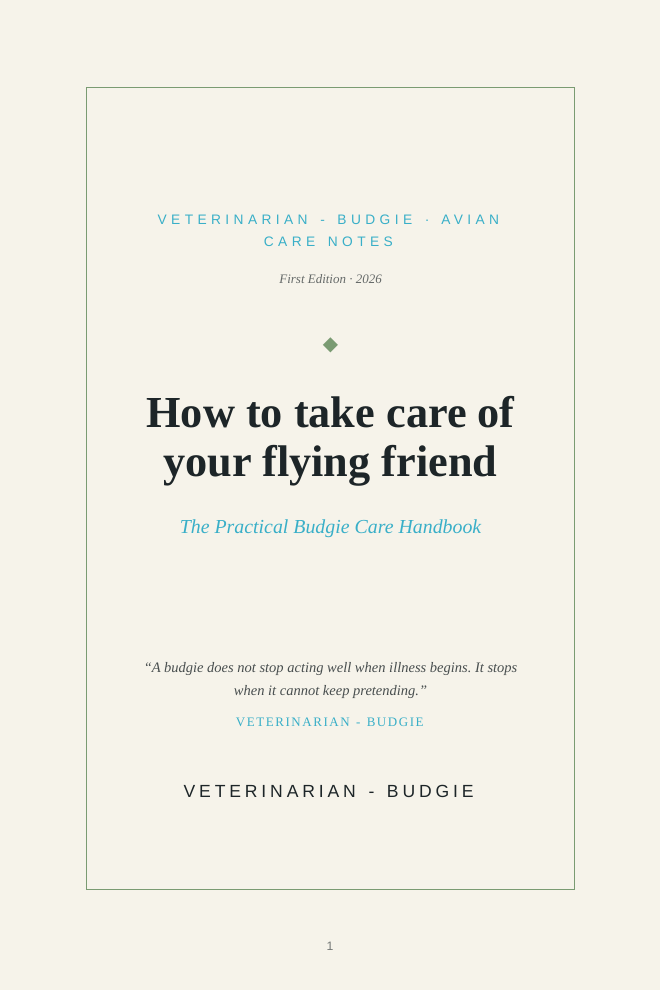
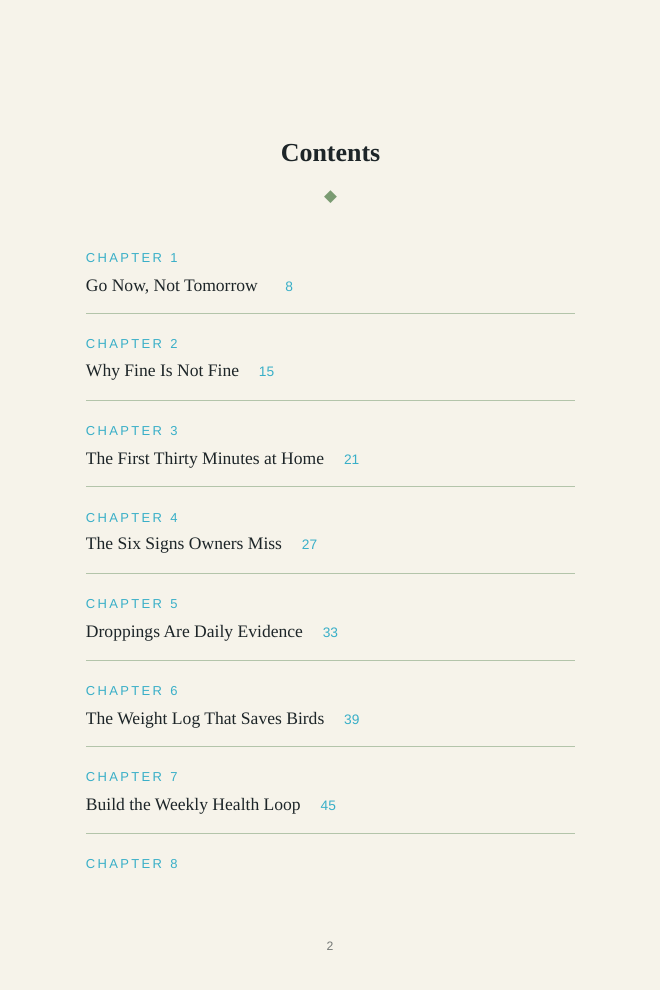
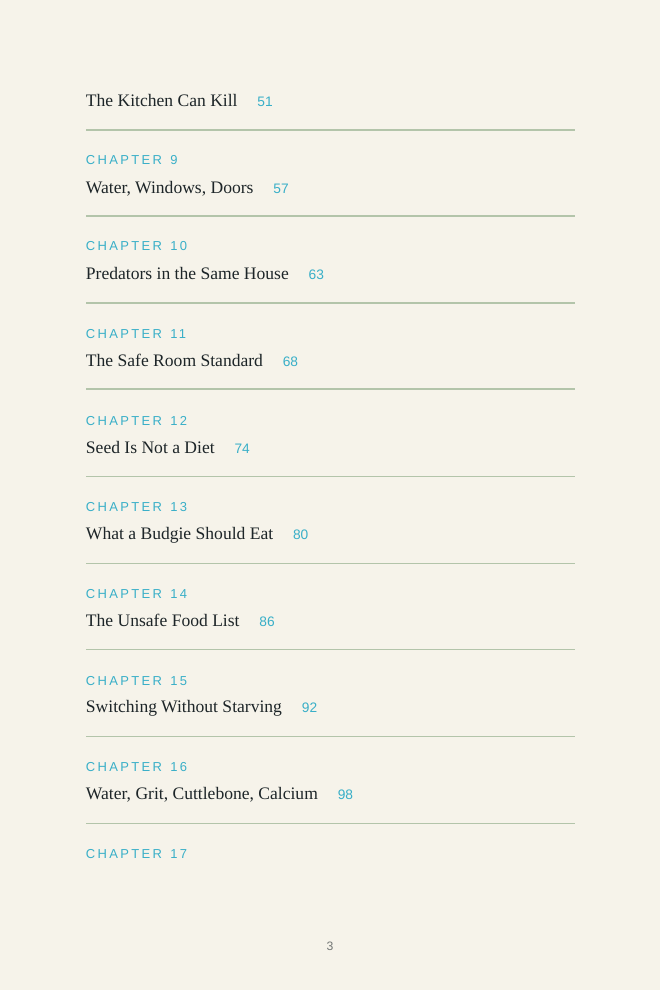
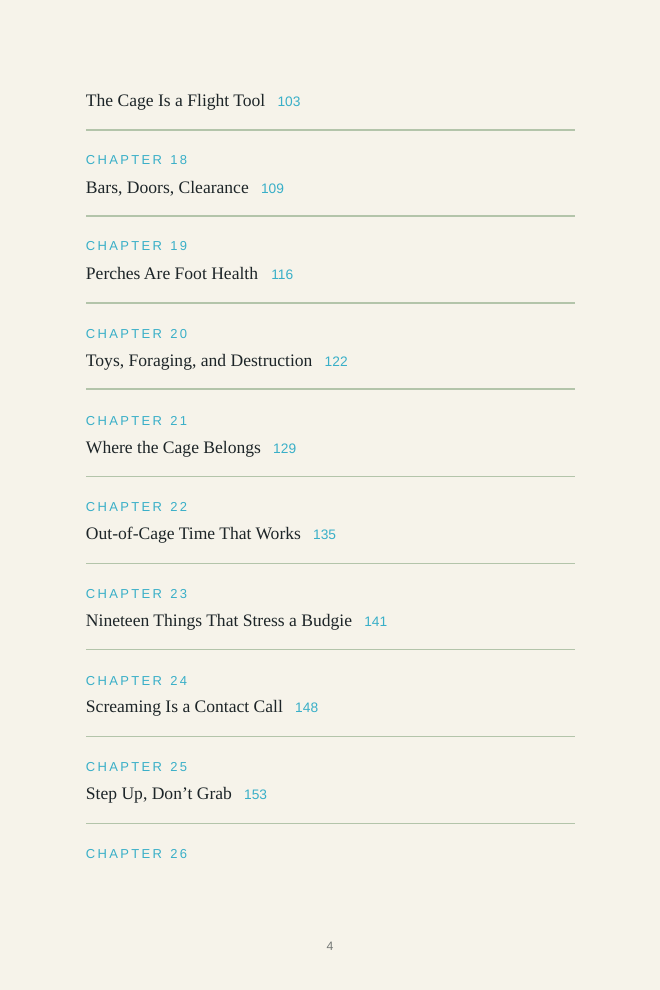
From the author’s audienceProof it is a real rendered handbook.
These pages show the format: direct headings, short sections, practical checks, and no filler.
Plain answers before you buy.
Six objections owners ask when the bird is small, the advice online conflicts, and the clock matters.
Does this replace an avian veterinarian?
No. It helps you recognize signs, improve the home, keep records, and know when to seek veterinary help. It does not diagnose your bird or teach home treatment for emergencies.
Is this only for brand-new budgie owners?
No. New owners get the first setup routine. Existing owners get the hazard sweep, weekly health loop, diet transition safeguards, cage checks, stress chapters, hormone sections, and vet planning.
My budgie eats seed. Will the book shame me?
No. It explains why seed-only feeding is risky, then gives a gradual transition approach with weighing safeguards and refusal signs. The point is safer change, not guilt.
Does it include emergency treatment instructions?
No. That would be unsafe. It lists the signs that mean seek avian veterinary help today and explains why waiting overnight can be dangerous with a small bird.
Can I read it on my phone?
Yes. You receive instant PDF access after purchase. You can read it on a phone, tablet, or computer, and you can print pages if you want cage notes or logs nearby.
What if it is not useful for my situation?
There is a seven-day refund window. If the handbook is not useful for you, request a refund inside that period.
How to take care of your flying friend.
A 219-page practical budgie care handbook on warning signs, food, cages, hazards, hormones, vets, and routines.
It exists because the dangerous moments in budgie care often look ordinary at first. A quieter bird. A little tail movement. A different dropping. A pan heating in the kitchen. A cat watching from the floor. A cage bought because the box said “budgie.”
veterinarian - BUDGIE wrote these chapters to make the hidden decisions visible. The order is deliberate: emergency first, then observation, then first setup, droppings, weight, hazards, rooms, food, cage structure, stress, sound, sleep, hormones, and vet readiness.
It is for the owner who wants to understand what matters before the bird is too weak to make the problem obvious.
- Owners looking for cute shortcuts instead of routine care.
- Anyone wanting to treat respiratory distress, bleeding, collapse, seizures, or egg binding at home.
- People who want reassurance that seed-only feeding, fumes, predators, or unsafe flight rooms are harmless.
One handbook. Immediate access. No waiting for shipping.
You get the complete rendered e-book in PDF format, ready to read or print.
The point is not to own more bird content. The point is to have a practical reference when you are choosing a cage, changing food, checking droppings, planning flight time, watching a hen strain, or deciding whether the clinic call waits.
Use seven days to decide whether it helps.
If the handbook is not useful for you, there is a seven-day refund window.
Open it. Read the emergency signs. Check the food section. Compare your cage and room against the safety chapters. If it does not give you clearer decisions, request a refund inside seven days.
Future updates to this edition are included free for life, so the PDF can remain a working reference instead of a one-time download.
Fine is not a diagnosis.
A budgie’s safety is built from small observations and ordinary room rules. This handbook gives you both.
If your bird is already showing emergency signs, contact an avian veterinarian now. If you are here because you want to prevent the next avoidable mistake, get the handbook and start with the first chapters today.
Written by veterinarian - BUDGIE. Practical, direct, and built for owners who want the truth before the crisis.